
Why Great E-Learning Does Not Start with Content
Many e-learning projects still begin in exactly the same way.
- There is content.
- There is a presentation.
- There is a structure.
- And then comes the question: how do we turn this into an online module?
At the Articulate User Day organised by Courseware, we explored that question from a different angle. Not by showing how to fill a module as quickly as possible, but by challenging the starting point itself.
Because great e-learning does not start with content.
She starts with a different question:
What should people do differently, understand better or apply more effectively after completing this learning experience?
The difference may seem subtle. In practice, it determines whether e-learning becomes digital information or a learning experience that genuinely changes behaviour.
From a blank page to learner activation
A blank page is not a problem. In many cases, it is actually a good place to start. As long as you do not rush to fill it.
Most organisations already have content available: presentations, documents, procedures, expert knowledge, product information or policy guidelines. The natural reaction is understandable: Everything should be included.
That is exactly why our session was called: From Blank Page to an Engaging Rise Module.
But more content does not automatically create more learning impact.
Strong e-learning starts with making deliberate choices.
- What is truly essential?
- What should learners recognise in practice?
- Which decisions should they be able to make more effectively?
Only when those questions are clear does content become relevant.
Why starting with content often goes wrong
Content matters. But content is rarely the right starting point.
When a module is built around everything that is available, it quickly becomes too long, too dense and too difficult to apply. Learners receive information. But they receive very little direction.
And that is where many e-learning projects lose their effectiveness.
People click through the content.
They may recognise the information.
They may even pass the assessment.
Yet very little changes in practice.
At Keep Growing, we therefore start with behaviour rather than content. What should people be able to do afterwards? What should happen differently in the workplace, during onboarding, in customer interactions or in everyday decision-making?
That is where the design process begins.
Not with: “What do we know?”
But with: “What should this achieve?
Activation makes learning relevant
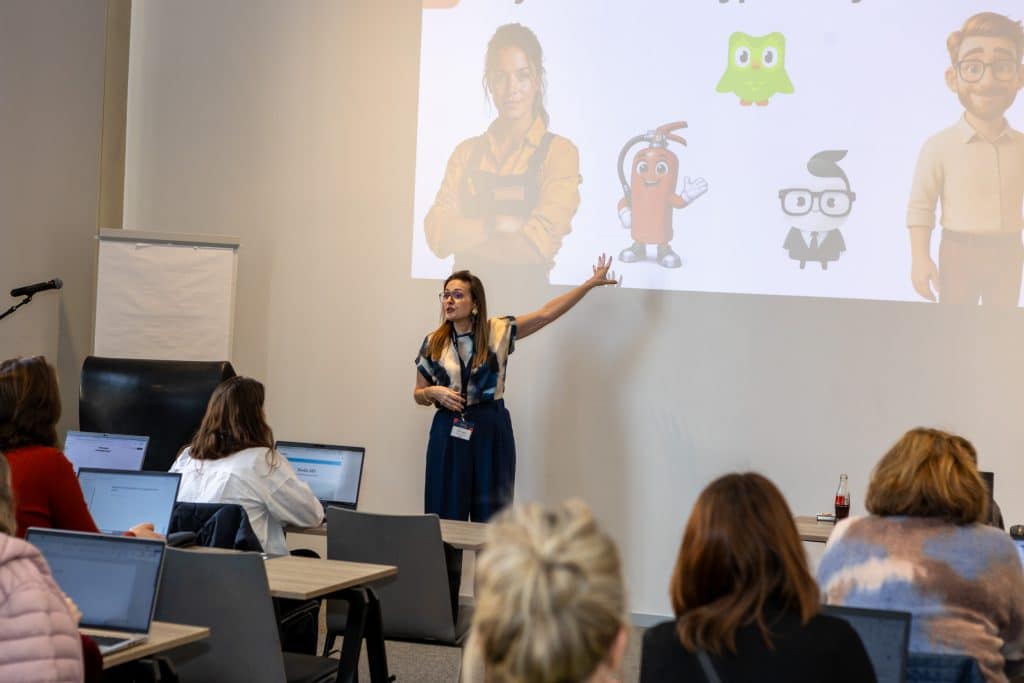
During the User Day, we worked with examples created in Articulate Rise 360. Characters, interactions and short self-assessments were all part of the discussion.
But the tool itself was never the point.
The real question was always: How do you activate the learner?
A character in an e-learning module only adds value when it serves a purpose. It may provide structure, direct attention, highlight a risk or encourage reflection. But if it only exists to make the module look more attractive, it contributes very little.
The same applies to interaction.
An interactive activity is not automatically better than text. A click is not automatically engaging. And attractive design does not guarantee learning impact.
The real questions are:
- Does this encourage learners to think?
- Does it help them make better decisions?
- Does it make the content more recognisable?
- Does it increase the likelihood of application?
If the answer is yes, interaction becomes functional. If the answer is no, it is mostly decoration.
Learners should do more than read
One of the most powerful design decisions in e-learning is to let learners start by thinking rather than reading. This can be achieved through:
- a short question
- a realistic scenario
- a self-assessment
- a reflection exercise
- a decision point with feedback
The result is a learning experience that immediately feels more personal. Learners quickly recognise that the content relates to their own situation, decisions and responsibilities.
That increases engagement. More importantly, it increases relevance.
When people first reflect on their own reality, they process the information that follows differently. With greater focus. With more critical thinking. And with a higher likelihood of transfer into practice.
That is the difference between passive content and a genuine learning experience.
What this means for organisations
This is not merely an instructional design preference. It has a direct impact on time, budget and results.
When e-learning starts with content, projects often become larger than necessary. Too much information is included. Focus is lost. Development time increases. And the likelihood of meaningful behaviour change remains limited.
When e-learning starts with activation, different choices are made.
The result is:
- less unnecessary content
- greater focus on application
- shorter and more effective modules
- stronger alignment with workplace reality
- more efficient use of development budgets
- a higher likelihood of behaviour change
That is where the real ROI of e-learning can be found.
- Not in the number of screens.
- Not in the number of interactions.
- Not in how comprehensive the content appears.
But in whether the learning solution contributes to fewer mistakes, faster onboarding, stronger adoption, greater consistency or better workplace conversations.
How we approach learning design at Keep Growing
At Keep Growing, we do not create learning solutions simply to digitise content.
We design learning experiences that are instructionally sound, practical and aligned with organisational reality.
That means looking beyond design and technology. We focus on:
- the learning objective
- the target audience
- the context in which application takes place
- the behaviour that needs to be strengthened
- the business impact the organisation expects
Through Keep Growing iDesign, we translate that philosophy into custom e-learning solutions. Not by placing information online, but by creating learning experiences that activate learners, provide direction and support application.
Sometimes that results in a short e-learning module. Sometimes it leads to a blended learning journey. Sometimes it requires a highly interactive experience. And sometimes it leads to the conclusion that e-learning is not the best solution at all.
That level of focus matters.
Because organisations do not need more digital content. They need learning solutions that help people perform better.
The question that makes every e-learning project stronger
The Articulate User Day reinforced something we already strongly believe: It is easy to move too quickly into development mode.
Tools are powerful.
Design can enhance learning.
Interaction can enrich the learner experience.
But only when the foundation is right.
That is why the most important question is not:
What should go into this module?
It is:
What should people do with it afterwards?
When you start there, you are no longer building a digital presentation.
You are creating a learning experience with direction, relevance and impact.
Ready to turn content into meaningful learning?
Do you have existing content that needs to become more than an information repository?
Keep Growing helps organisations determine what is truly necessary, which format works best and how learning solutions can support behaviour change, application and measurable results.
Through Keep Growing iDesign, we create custom e-learning that is instructionally strong, visually clear and designed for impact.
Let’s explore where your learning solution still starts with content and where activation could make the difference.
Share on:


Related blogs
-

Why Keep Growing takes a different approach to e-learning
Read more: Why Keep Growing takes a different approach to e-learning -

Why Keep Growing takes a different approach to e-learning
Read more: Why Keep Growing takes a different approach to e-learning -

Why Keep Growing Prefers to Be a Partner Rather Than a Supplier
Read more: Why Keep Growing Prefers to Be a Partner Rather Than a Supplier