
E-learning as preparation for live training
Many organisations still deliberately invest in live training. Rightly so.
When you really want people to practise, discuss cases, sharpen behaviour or make room for interaction, a strong face-to-face session remains particularly valuable.
Yet in many programmes, that contact time still too often goes to basic explanations, setting the context and aligning on concepts. Understandable, but expensive. Because the very time in which participants can practise and go deeper together with a trainer is then spent on things that could perfectly well happen beforehand.
That is why organisations increasingly use e-learning not as a replacement for live training, but as preparation for it.
And that is a fundamental difference.

The goal is not to digitise, but to make live time more valuable
Many discussions about e-learning get stuck in the wrong opposition. As if you have to choose between digital or live.
For strong learning journeys, that is usually too simple a question. The relevant question is: which part of this learning process is best done beforehand, which part requires human interaction and which part needs reinforcing afterwards?
Seen that way, preparatory e-learning makes sense. Basic knowledge, terminology and a first orientation don’t have to happen in a classroom. Participants can go through them beforehand, at their own pace and at a moment that suits them.
As a result, the live session shifts from broadcasting to applying.
Live training gets stronger when participants arrive prepared
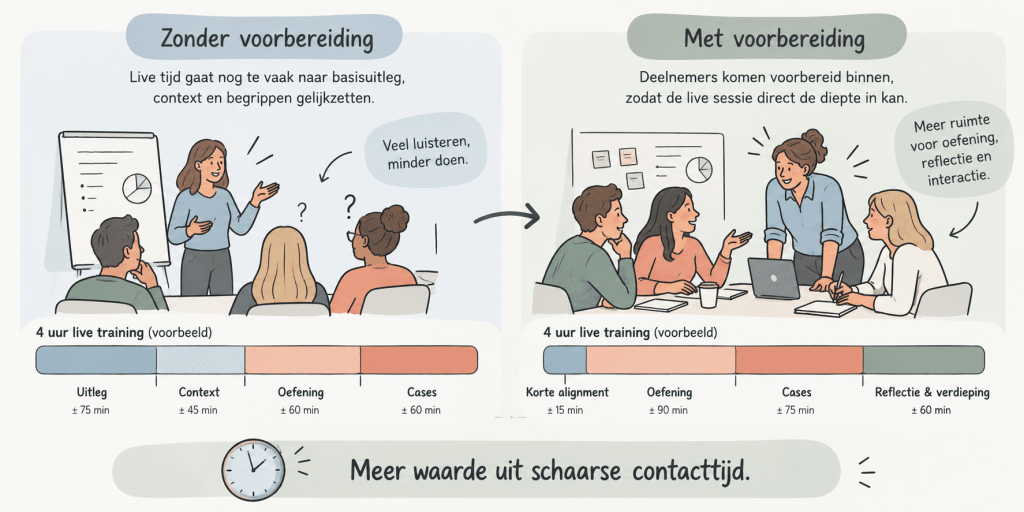
A live session with unprepared participants often starts at the lowest common level. The trainer first has to explain, align and check whether everyone is on board.
That takes time. More importantly, it limits what you can really do live.
When participants already get familiar with the basics through e-learning beforehand, the dynamics of the session change. There is a shared starting point sooner. Terminology needs less explaining. The trainer can go deeper faster. There is more room for practice, reflection and interaction.
That makes live training not only more efficient, but also more valuable.
Especially logical when live time is scarce or expensive
Not every learning journey needs preparatory e-learning.
But in many contexts it is a particularly logical choice. Especially when live training is intensive, costly or logistically complex. Think of programmes with a lot of hands-on practice, technical training, external audiences or academies that want to guarantee quality at scale.
In those contexts, you want to avoid spending live time on basic content that can be transferred in other ways. You want participants to arrive prepared, so the trainer can start with value instead of explanation.
Only strong when it is functionally embedded
This is also where it often goes wrong.
Some organisations simply put a digital module before a training and call it blended learning. But an extra module does not in itself make a strong blended programme.
Preparatory e-learning only works when the participant understands why the preparation is needed, the content is selectively chosen and the live session actually builds on what happened beforehand.
Otherwise you get extra learning time without extra learning value.
A strong approach looks different. Beforehand, participants get exactly the knowledge and context they need to start the live session well. During the training, the focus shifts to application and depth. Afterwards, reinforcement or performance support follows where needed.
That creates one coherent learning journey.
Why this is extra relevant for academies
For academies, training institutes and organisations that train customers or partners, preparatory e-learning has an extra function. It doesn’t just raise learning quality. It also professionalises the training model.
When you prepare participants in a targeted way, you create more consistency across groups, trainers and locations. You depend less on how each trainer explains the basics. You make live sessions more scalable without hollowing out their content.
In that context, preparatory e-learning is not an extra. It becomes a structural part of how you safeguard quality.
The real value
So the strength of preparatory e-learning doesn’t lie in the module itself.
It lies in what it makes possible. Getting to practice faster. Richer conversations. More complex cases. More active participants. More value from scarce contact time.
Not from live to digital.
But from explanation to application.
And that is exactly why preparatory e-learning is increasingly becoming a logical choice in strong learning journeys.
Share on:


Related blogs
-

AI Literacy is not prompt training: from AI policy to safe behaviour in the workplace
Read more: AI Literacy is not prompt training: from AI policy to safe behaviour in the workplace -

Why Keep Growing takes a different approach to e-learning
Read more: Why Keep Growing takes a different approach to e-learning -
Case Study: Turning HR Policies into Microlearning That Employees Actually Use
Read more: Case Study: Turning HR Policies into Microlearning That Employees Actually Use