
Case Study: E-Learning for Robotic Surgery Training with Orsi Academy
In robotic surgery training, hands-on practice is far too valuable to spend on basic explanations.
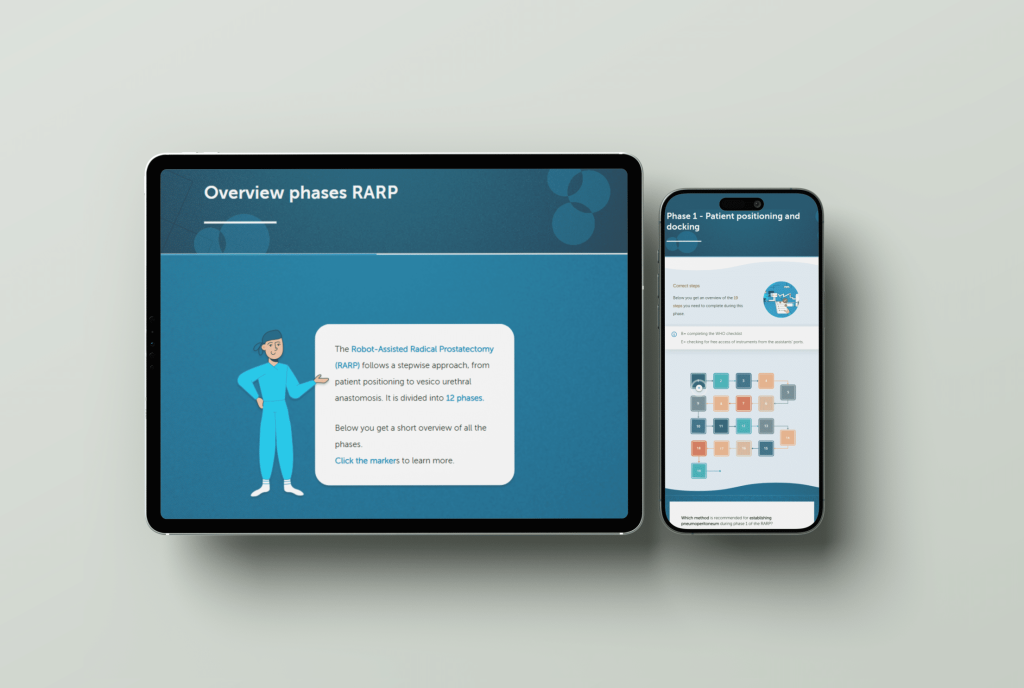
That is why Orsi Academy, together with Keep Growing iDesign, uses e-learning as preparation for face-to-face robotic surgery training. Through digital pre-learning, surgeons become familiar with key terminology, core concepts, procedural logic and critical decision points before they enter the training environment.
As a result, live training can focus more quickly on where it creates the greatest value: practising, receiving feedback and refining skills in a realistic setting. This case is not about adding more content. It is about making better use of valuable practice time.

The role of Keep Growing iDesign: translating complex expertise into practical e-learning
The medical expertise sits with Orsi Academy. The challenge for Keep Growing iDesign is to translate that expertise into a learning experience that is logical, manageable and effective for busy medical professionals.
That requires more than simply digitising content. It requires careful learning design. What should participants understand before attending the live training? Which concepts and procedures need to be mastered first? Which critical decision points deserve extra attention? How should the e-learning connect to the practical training that follows?
This is where instructional design creates value. Not by making information look better, but by creating preparation that enables application.
Building a shared foundation before live training
When participants already understand key terminology, procedural logic and critical concepts before attending a live session, the training starts from a stronger baseline.
The session no longer needs to begin with basic knowledge transfer. Instead, it can move more quickly towards demonstration, practice, feedback and refinement. This makes the learning environment significantly more valuable because limited face-to-face time is used for the activities that benefit most from expert guidance.
For Orsi Academy, e-learning is not a replacement for practical training. It is a way to increase the quality, consistency and effectiveness of that practical training.
Procedural training requires a clear instructional structure
Learning robotic surgery is not just about understanding separate components. Participants also need to understand how each step connects to the next, where critical moments occur and how specific decisions can influence the course of the procedure.
That is why e-learning in this context only becomes truly effective when it builds a mental framework before practice begins. Participants move through the content step by step, in a logical sequence. Key points of attention are introduced in advance, and the connection with the later practical training remains visible throughout.
This distinction matters. E-learning should not become a digital syllabus. It should help participants enter the practical training environment with more structure, recognition and focus.
Instructional design is not a detail. It is a prerequisite.
Creating e-learning for surgeons requires more than accurate content. The structure must be clear. The learning objectives must be focused. The content must remain manageable.
For highly specialised professionals, information overload quickly becomes counterproductive. Short, focused learning units are therefore not a luxury. They are a deliberate design choice that determines whether preparation actually takes place.
At Keep Growing iDesign, we do not measure success by whether every piece of information has been included.
The more important question is: Will this e-learning help participants learn more effectively when they enter the practical training environment? Will it help them practise with greater understanding, focus and confidence?
Mobile-friendly is simply smart design in this context
Orsi Academy’s audience consists of busy medical professionals. Learning does not always happen at a desk. More often, it takes place between consultations, procedures or while travelling between locations.
A mobile-friendly approach lowers the barrier to preparation. Access via smartphone and tablet makes learning more realistic within the daily context of the participant.
This is not a technical detail. For audiences with limited time, accessibility plays a key role in whether preparation actually happens.
The real value: making better use of valuable practice time
The business impact of this type of e-learning is not found in reducing training. It lies in making better use of expensive, limited and highly valuable face-to-face training time.
When participants arrive prepared, live training can focus more quickly on the activities that create the greatest value: practising, observing, receiving feedback, discussing decisions and refining performance. This increases the quality of the entire learning journey.
For academies and training organisations, that is an important lesson. Digital preparation is not an extra layer of content. It is a design choice that strengthens the entire blended learning model.
What other academies can learn from this
The Orsi Academy case is relevant far beyond robotic surgery.
Any academy or training organisation working with complex subject matter, limited face-to-face time and professional learners can benefit from the same approach. Especially when live sessions are expensive, content is highly technical and participants need to arrive better prepared.
The lesson is simple. In this context, e-learning does not replace practice. It prepares learners for it. By creating a shared starting point, digital preparation improves the quality of live training and makes the overall learning model more consistent.
That is where the real value lies.
Not in adding more content.
But in making better use of valuable practice time.
Want to see how digital preparation can enhance your training program?
Share on:


Related blogs
-

Why Keep Growing takes a different approach to e-learning
Read more: Why Keep Growing takes a different approach to e-learning -

Why Keep Growing takes a different approach to e-learning
Read more: Why Keep Growing takes a different approach to e-learning -
Case Study: Turning HR Policies into Microlearning That Employees Actually Use
Read more: Case Study: Turning HR Policies into Microlearning That Employees Actually Use